SIGNAL 02 // PHYSICAL LAYER // WHERE WE CAME FROM
TWO ROBOTS STARTED AS A TABLETOP GAME. IT COULD END THERE TOO.
▶ ORIGIN AND HORIZON
1,200+ physical copies of Two Robots shipped worldwide before there was a single line of code in the digital game. That community — the people who played the tabletop version, who gave the earliest feedback, who believed in the concept before there was a product — is the original proof of demand.
The physical game is on pause. Not abandoned. On pause. Because the digital game had to come first. But there is a long horizon where the physical and digital worlds converge in a way that has never been done before in gaming.
▸ FIELD EVIDENCE // WHERE IT STARTED
1,200+ COPIES SHIPPED WORLDWIDE
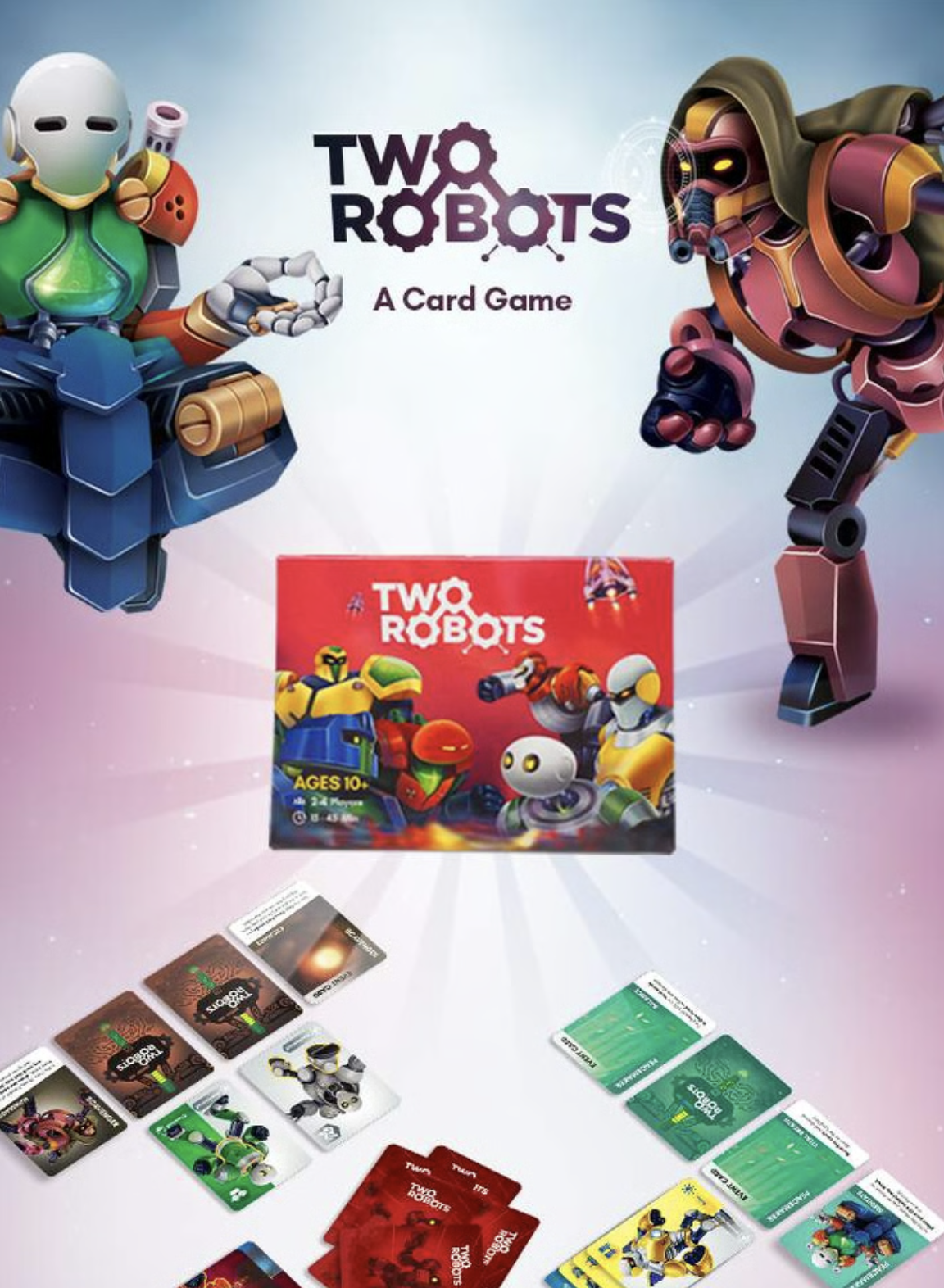
THE ORIGINAL TWO ROBOTS
Physical tabletop card game · Shipped before a single line of code existed · Proof of demand before the product
SCANNABLE PHYSICAL CARDS WITH ON-CHAIN OWNERSHIP
DIRECTIONAL
CONCEPT // BLOCKCHAIN + PHYSICAL // LONG HORIZON
Imagine a physical Two Robots card with an NFC chip or QR code embedded in it. You scan the card with your phone. It unlocks the digital version of that card in your TRU client — with the same genetic properties, the same provenance, the same match history. The physical card is the certificate of ownership. The blockchain record is the proof. You could trade the physical card and the digital card transfers with it. You could display the physical card and know that no one else in the world has an identical one. Pop Mart sells blind boxes. We sell provenance. The tabletop game was always the origin story. This is the sequel.
PHYSICAL BOOSTER PACKS WITH DIGITAL UNLOCK MECHANICS
DIRECTIONAL
CONCEPT // COLLECTIBLE ECONOMY // LONG HORIZON
The Pokémon TCG Pocket app hit 30 million users in its first weeks. It succeeded because it gave digital players the feel of opening a physical booster pack. We can invert this: physical booster packs that give physical collectors the feel of digital randomness — with on-chain verification that their pull is genuinely rare. A physical Shruce card with a holographic genetic variant pattern that matches the on-chain record. One exists in the world. Yours. The tabletop game proved there is a physical community for this IP. The digital game proves there is a competitive community. The fusion of the two is a category that does not exist yet.
LIVE EVENT CROSSOVER — PHYSICAL TOURNAMENTS THAT AFFECT THE DIGITAL WORLD
SPECULATIVE
CONCEPT // EVENTS + CROSSOVER // LONG HORIZON
Magic: The Gathering Pro Tour events are attended by thousands and watched by hundreds of thousands. The outcome of those tournaments shapes the meta for millions of kitchen table players worldwide. We have the architecture for something new: a physical TRU tournament where the outcome affects the Rennova world directly. A clan that wins the physical championship earns territory in the digital game. A card combination discovered at a live event gets named after the player who found it. The physical and digital worlds share one economy. We came from tabletop. We know how to bring people to a table.
▸ CONCEPT DEMONSTRATION // PHYSICAL-DIGITAL CARD BRIDGE
DIRECTIONAL
▸ LIVE BRIDGE // SCAN → SUMMON
SCAN THE CARD. OWN THE ASSET.
Every physical Two Robots card carries a unique signature. Scan it once — the digital twin enters your Rennova collection. One card. Two worlds. One owner. The cardboard in your hand and the asset in the game are the same object.
DIRECTIONAL CONCEPT · The bridge protocol is in design. Animation shown is illustrative of the player-facing moment we are building toward.
Two Robots began in the physical world. The digital game is chapter two. Chapter three is the world where physical and digital ownership are the same object.
SIGNAL 02.5 // TRUE OWNERSHIP // THE WORLD IS CHANGING AND PLAYERS ARE WATCHING
THE OWNERSHIP IS NOT A SHIP NAME. IT IS A THESIS.
▶ THE WORD CARRIES WEIGHT // ON PURPOSE
We named the top clan ship The Ownership intentionally. Not because it sounds cool — though it does. Because the word carries weight that we want players to feel every time they see it docked in orbit.
The world is entering a period of financial uncertainty that a generation of young people is navigating in real time. They are watching institutions fail to protect ordinary people. They are watching digital assets get rug-pulled by the people who issued them. And they are watching the promise of true digital ownership get co-opted by the same intermediaries it was supposed to route around.
TRU is designed to be the first game that teaches player-owned digital assets through play — not through a whitepaper, not through a crypto pitch, but through the experience of earning something genuinely yours and understanding why it matters that no one can take it.
THE OWNERSHIP IS EARNED, NOT BOUGHT
DESIGN PRINCIPLE
ECONOMY DESIGN // PLAYER SOVEREIGNTY
The Ownership ship belongs to the top clan in Rennova every season. It cannot be purchased. It cannot be inherited. It must be won competitively and then defended. When the season ends, it may change hands. This mechanic teaches a specific lesson: ownership in Rennova is conditional on continued excellence. It is a living, contested asset — not a permanent entitlement. That is closer to how real ownership works than most games are willing to admit.
THE BLOCKCHAIN WALLET IS INVISIBLE BY DESIGN
UX PHILOSOPHY
THIRDWEB INTEGRATION // PLAYER EDUCATION
When a player goes premium in the standalone client, a blockchain wallet is created automatically in the background. No seed phrase. No gas fees. No confusing UI. The player sees a ship upgrade. Behind the scenes, they now have a non-custodial wallet attached to their identity — one that can hold Biobot cards, ship skins, and territorial stakes as genuine on-chain assets. The goal is not to make players crypto-native. The goal is to make players asset-native. The blockchain is the infrastructure. The ship is the experience.
THE STANDALONE CLIENT IS THE BRIDGE TO SOVEREIGNTY
STRATEGIC ARCHITECTURE
MIGRATION PATH // STEAM TO STANDALONE
Steam gives us discovery. Our standalone client gives players sovereignty. The migration path — Steam player becomes premium standalone client player becomes Friendship ship owner — is the product journey we are designing toward. Every step deeper into our ecosystem is a step further away from platform dependency and a step closer to genuine player ownership. The Friendship is named for what the best gaming communities are built on: the choice to stay. The Ownership is named for where that choice leads when you are the best in the world at it.
We are not building a crypto game. We are building a game with a wallet underneath it — the same way every banking app has a ledger underneath it and most users never think about the ledger. The difference is that our ledger belongs to the player. Not to us. Not to Steam. Not to any platform that can change its terms mid-season. The world is going to need more products that make that distinction legible. TRU is designed to be one of the first games that teaches it through play.
// THE OWNERSHIP. OWNER + SHIP. THE WORD HAS ALWAYS MEANT BOTH THINGS AT ONCE.
SIGNAL 03 // SPATIAL COMPUTING // WATCHING THE SIGNAL
WE DID NOT BUILD FOR VR. WE BUILT FOR THE WORLD VR WILL NEED.
▶ THE VR INFLECTION HAS NOT ARRIVED YET
Meta spent $64 billion and failed because they built the hardware before the world. Apple Vision Pro at $3,500 proved the same lesson. The VR inflection point has not arrived yet.
But Steam is investing in VR infrastructure. The Steam Deck proved Valve understands that the future of PC gaming is spatial and portable. When the hardware floor for spatial computing drops to $400 — and it will — the games that win will be the ones that were built for persistence, for social presence, and for real stakes.
TRU is already that game. We just do not require a headset to play it.
CONDITIONAL // WATCHING THE HARDWARE SIGNAL
IF THE FLOOR DROPS TO $400
The spectator arena is already a first-person space environment. Players already fly through orbital space in Rennova. Adding a VR layer to spectate mode is not a redesign — it is a rendering mode.
When you put on a headset and fly through orbital space watching card battles on asteroids around you, with scraps floating past you waiting for your gravity gun — that is the VR moment this category has been waiting for.
We are on Godot, which has native XR (extended reality) support. The engine already knows how to render for VR. We would not be building from scratch.
Our decision to use Vulkan-optimized rendering means we are already on the graphics pipeline that VR headsets require. This was not a VR decision. It was a performance decision that happens to be compatible with VR.
SPECULATIVE // WATCHING THE MARKET
THE WORLD AS THE ARENA
Imagine the gravity gun fight not on a screen, but layered over your physical environment. AR overlays the Rennova orbital arena onto your kitchen table. The scraps float in your living room. Your gravity gun is your hand.
This is not a near-term priority. It is a long-term observation: the Biobot discovery mechanics — the Shruce hunt through your ship's vent system — translate naturally to AR. The vent system becomes your real-world environment. The Shruce hides behind your real furniture.
The collectible provenance economy that TRU is building is the exact foundation that makes AR collectibles valuable. A Shruce you caught in AR, in your home, with your specific location and timestamp on-chain — that is a different kind of rare.
We did not build TRU for VR or AR. We built it for a used GTX 1650 Ti. But the decisions we made — Godot, Vulkan, server-authoritative physics, persistent world, provenance economy — are the exact decisions that make a spatial computing pivot possible without starting over.
SIGNAL 04 // THE TRU METAVERSE // WHAT ZUCKERBERG MISSED
THE METAVERSE IS NOT A DESTINATION. IT IS A CONSEQUENCE.
▶ THE INVERSION
Meta built infrastructure for a world nobody wanted to live in. They started with the container and hoped the people would come.
TRU inverts this. We started with the people — the card game community, the FPS community, the tabletop original community — and built a world that they already want to live in. The metaverse is not a product we are launching. It is what happens when enough people share one persistent world for long enough.
The three stages of the TRU Metaverse:
Meta tried to skip to Stage 3. They spent $64 billion discovering you cannot. Roblox spent 10 years on Stage 1 before Stage 2 and 3 emerged naturally. We are in Stage 1. We know it. The raise funds Stage 2. Stage 3 follows from both.
SIGNAL 04.5 // CLASSIFIED // THE LORE LAYER // FOR THE ATTENTIVE
THE FACTIONS ARE NOT FIGHTING OVER TERRITORY. THEY ARE FIGHTING OVER REALITY.
▶ LORE DEPTH // NOT REQUIRED READING // BUT WORTH IT
Most players will never know this. Most investors will not ask about it. But it is there — in every faction description, every Mechommander design, every territorial conflict on the planet Rennova.
The six factions of Two Robots: Unleashed were not invented to give players something to choose between. They were derived from one of the most sophisticated frameworks in developmental psychology: Clare Graves' theory of human value systems, later developed by Don Beck and Christopher Cowan into what became known as Spiral Dynamics.
Each faction represents a different level of human consciousness. Each one is complete in itself. Each one is also, from the perspective of any higher level, partial. And the tragedy of Rennova — the war that the card game enacts — is that none of the factions can see far enough to understand why the others exist.
That is not a game mechanic. That is the human condition.
▶ THE SIX FACTIONS // THE SIX LEVELS // THE ONE PLANET
RADIXPLOR
FACTION 01 // GREEN // CHEMICAL
LEVEL: COMMUNAL // HUMAN BOND // RELATIVISTIC
Radixplor believes in the collective above the individual. Resources shared. Decisions by consensus. The faction that corrodes and outlasts — not through aggression but through patience and community. Their chemical warfare is not cruelty. It is the slow dissolution of boundaries between self and world. They do not conquer Rennova. They become it.
LYSAFAR
FACTION 02 // BLUE // ELECTRICAL
LEVEL: PURPOSEFUL // TRUTH FORCE // ORDER
Lysafar believes in structure, speed, and righteous purpose. The faction of Quick Charge and Shocking Blow — moving with precision because the mission demands it. They are not fast for the sake of winning. They are fast because the Way requires it. Order, hierarchy, and divine certainty animate every circuit. They believe Rennova has a correct shape. They are trying to find it.
IGNAETER
FACTION 03 // RED // NUCLEAR
LEVEL: EGOCENTRIC // POWER GODS // IMPULSIVE
Ignaeter operates on pure power. Gratify. Dominate. Explode. There is no long-term strategy — only the immediate assertion of force. Their Unstable bots self-destruct because restraint is not in their vocabulary. They are not evil. They are pre-moral: operating below the threshold where consequences matter. They are the most dangerous faction and the most honest one. They want what they want and they take it.
CIVARDUS
FACTION 04 // YELLOW // SOLAR
LEVEL: STRATEGIC // STRIVE DRIVE // ACHIEVEMENT
Civardus is the faction of rational self-interest and technological optimism. Generator bots that compound resources. Siphon mechanics that extract value from opponents. They believe the best solution wins — and they are usually right. They are also the faction most likely to mistake winning for meaning. Their tragedy is efficiency without wisdom: the faction that optimizes everything except the question of what is worth optimizing.
VITAUS
FACTION 05 // WHITE // MECHANICAL
LEVEL: CLANNISH // KIN SPIRITS // TRADITION
Vitaus is the faction of protection, loyalty, and sacred tradition. Taunt to protect the vulnerable. Guard to absorb punishment. Linked bots that sacrifice themselves for allies. They are the oldest faction on Rennova — the keepers of pre-war mechanical knowledge. Their strength is cohesion. Their limitation is that they cannot imagine why anyone would do things differently. They protect what they love by refusing to question it.
N.O.V.A.
FACTION 06 // BLACK // ALL ENERGIES
LEVEL: INSTINCTIVE // SURVIVAL SENSE // PRE-CONSCIOUS
N.O.V.A. is the most misunderstood faction. They use all energy types because they have no allegiance to any single truth. Hack. Hijack. Duplicate. Assimilate. They look chaotic because they are operating at a level the other factions cannot read. They are not nihilists. They are the shadow that holds the mirror up to every other faction and shows them what they are missing. N.O.V.A. is the faction that wins by making every other faction question its own assumptions.
▶ THE WAR BENEATH THE WAR
The war on Rennova is not about territory. Territory is just what the factions can see from where they are standing.
The real conflict is epistemological: six groups of beings, each with a complete and internally coherent worldview, each unable to recognize the others as anything other than obstacles or enemies. Radixplor cannot understand why Ignaeter will not share. Ignaeter cannot understand why Vitaus will not fight. Vitaus cannot understand why N.O.V.A. will not commit to a side. And none of them can see the possibility that all six of their worldviews are simultaneously valid — partial expressions of a larger consciousness that Rennova has not yet produced.
That is the lore. That is also a description of Earth in 2026.
The game does not preach this. It enacts it. Players choose a faction, inhabit its logic, play its mechanics, and win or lose by its philosophy. The most sophisticated players begin to notice that each faction has real strengths and real blindspots. A few will begin to wonder what a deck that transcended faction would look like.
That is the game within the game.
Clare Graves called this progression “the never-ending quest.” Don Beck and Christopher Cowan mapped it as a spiral. Ken Wilber built an entire integral philosophy around it. We built a card game. The destination is the same: a being who can hold all six levels simultaneously without collapsing into any one of them.
In Rennova, we call that player The Mechommander.
▶ THE LONG GAME // USER-GENERATED MECHOMMANDERS
Each faction currently has a roster of Mechommanders — the player's proxy on the battlefield, with unique abilities and powers. The long-term design vision includes player-created Mechommanders: characters built, named, and contributed by the community, belonging to specific factions, carrying the philosophy of that faction in their mechanics.
A Radixplor Mechommander built by a player in Brazil. A Lysafar Mechommander built by a player in Seoul. A N.O.V.A. Mechommander built by no one knows who, carrying abilities that none of the other factions recognize.
This is not a roadmap item. It is a design intention. The game was always meant to be a world that the players finish building. The six factions are the starting conditions. What emerges from them — that is the part we cannot predict and do not want to.
// SIX FACTIONS. SIX LEVELS OF CONSCIOUSNESS. ONE PLANET THAT DOES NOT YET KNOW IT IS ONE.
SIGNAL 05 // THE ASK BENEATH THE ASK
WE KNOW WHAT THE $750K FUNDS. THIS PAGE IS ABOUT WHAT MONEY CANNOT BUY.
▶ WHAT WE NEED FROM THE RIGHT PARTNERS
The capital is specific. The round is assembling. That is on the previous pages.
This page is about the conversation that happens after the check clears. The long-horizon pivots described above — physical card resurrection, AR/VR adaptation, the metaverse platform layer — none of them require capital today. All of them require wisdom now.
We are looking for partners who have seen platform transitions before. Who understand what it looks like when a game becomes an economy. Who can tell us when the VR signal is real versus when it is another $64 billion mistake. Who have strong opinions about when to add physical card distribution to a digital game and when to wait.
The money gets us to Stage 2. The right people in the room get us to Stage 3.
WHAT WE NEED // PATTERN RECOGNITION
PEOPLE WHO HAVE SEEN PLATFORMS SHIFT
Someone in this room has watched a community product go from 30 users to 30 million. We want their opinion on when our numbers are telling us to accelerate and when they are telling us to consolidate.
WHAT WE NEED // PHYSICAL GOODS EXPERTISE
PEOPLE WHO UNDERSTAND PHYSICAL + DIGITAL CROSSOVER
The physical card pivot is not a technology problem. It is a supply chain, retail, and collectible market problem. We want people who have shipped physical goods to a global collector community — or invested in someone who did.
WHAT WE NEED // LONG HORIZON PATIENCE
PEOPLE WHO THINK IN DECADES
Roblox took 10 years. Minecraft took 5 before the Microsoft acquisition changed the trajectory. TRU's platform vision is a decade bet. We want partners who understand that and price accordingly.