SECURE INVESTOR TERMINAL · v2.0.4
CLEARANCE REQUIRED — RETURN WITH AUTHORIZATION
SYSTEM BOOT 0%
RENNOVA UPLINK NODE: ARCHITECTURE-BRIEF CLEARANCE: ENGINEERING
SECURE CH.05 APR 28 2026
← /coreloop  ·  START HERE IF YOU HAVEN'T
RENNOVA INVESTOR INTERFACE

TWO ROBOTS.

SYS// TWO ROBOTS STUDIOS — APRIL 2026
ARCHITECTURE BRIEF
CHANNELCH.05
CLEARANCEENGINEERING
LAYERTECHNICAL MOAT
ACCENTSILVER FACTION

THE GAME IS BUILT ON AN ENGINE NOBODY ELSE IS USING THIS WAY.

▶ ORIENTATION // TECHNICAL FOUNDATION

This page is for people who want to understand the technical foundation before they write a check. The moat is not the game design. The game design is the product. The moat is the infrastructure underneath it — the engine choices, the server architecture, the DevOps pipeline, and the scalability framework that makes 100,000 concurrent players on a $400 PC achievable.

Every technical decision on this page was made deliberately. Here is why.

← /deployment // CAPITAL DEPLOYMENT

WE CHOSE THE ENGINE NOBODY ELSE CHOSE. ON PURPOSE.

INDUSTRY STANDARD // STRATEGIC LIABILITY

THE WALLED GARDEN

// WHY WE DID NOT USE THEM
Unity and Unreal are extraordinary tools for most games. They are the wrong tools for ours.
Closed source — you cannot patch at the engine level. You are a tenant, not an owner.
Runtime fee controversies exposed the business risk: Unity changed its pricing mid-game for developers. Your infrastructure is subject to their board decisions.
Built for AAA studios with unlimited compute budgets and dedicated DevOps teams.
Never designed for 100,000 concurrent players on consumer hardware. The architecture assumptions are fundamentally misaligned with our scale target.
Royalties, seat licenses, enterprise tiers — the cost structure penalizes success.
TWO ROBOTS // ACTIVE ARCHITECTURE

THE OPEN SOURCE ADVANTAGE

// WHY GODOT CHANGES EVERYTHING
Open source under MIT license. We go directly into the engine source. No middleman. No license risk.
Custom threading models written specifically for our persistent world topology. No other studio has done this on Godot at this scale.
Direct RenderingServer API access — we bypass the high-level scene tree for rendering-critical systems, getting GPU calls with minimal overhead.
MultiMesh batching for our orbital environment — thousands of objects drawn in single GPU calls.
Vulkan-optimized rendering pipeline designed for 2019-era consumer GPUs. A GTX 1650 Ti is our floor.
Server-authoritative physics: clients send inputs, not physics state. One stable 5 Mbps connection handles full sync — the same requirement as Netflix standard definition.
W4 Games, the company that maintains Godot, has taken notice of our engine-level work. That relationship is developing.
When Unity changed its runtime fee in 2023, thousands of studios scrambled. We were not affected. We will never be affected. Our engine is ours. That is not a small thing.
▶ THE BACKEND // THREE SERVICES, ONE REAL-TIME HUB
TR-SOCIAL
Chat · DMs · Friends · Presence · WebSocket auth
GO // :4000
TR-CORE
Auth · User profiles · Party · JWT issuer · Card inventory
NESTJS // :5000
TR-RAOBOTIX
Game engine · Matchmaker · Spectator · Card abilities · Anti-cheat
GO // :9090
// All three services route through Centrifugo. No client ever speaks directly to a backend. Everything is mediated, authenticated, and logged.

MOST STUDIOS SCALE THEIR SERVER WHEN THEY NEED TO. WE ALREADY DID IT.

▶ INFRASTRUCTURE EVOLUTION

The single biggest technical risk for a multiplayer game at launch is infrastructure failure under load. Studios that did not build scalable server infrastructure before launch have lost hundreds of thousands of players in the first 48 hours — not because the game was bad, but because the servers could not hold them. We solved this problem before we needed to. Here is what that means in practice.

BEFORE CODELAUNCH // SINGLE EC2 INSTANCE RISK // SINGLE POINT OF FAILURE
Before CodeLaunch, TRU ran on a single EC2 instance. This is standard for early development — it is fine for 30 closed beta players. It is catastrophic for a public launch. One server. One region. If it goes down, the game goes down. No auto-scaling. No regional failover. No traffic routing. This is where most studios are when they launch.
CODELAUNCH USA 2026 // VPC + TERRAFORM ARCHITECTURE COMPLETE ✓
As part of CodeLaunch USA 2026, a senior DevOps engineering team upgraded our entire server architecture from that single EC2 instance to a VPC (Virtual Private Cloud) managed by Terraform. This is not a minor upgrade. This is the foundation of every scalable cloud-native game in production today. Terraform is infrastructure-as-code: the server configuration lives in version-controlled files, not in a single human's memory or a dashboard. Any engineer on the team can read exactly what the infrastructure does. Any change is reviewed, logged, and reversible. This infrastructure upgrade was completed with the support of a senior DevOps engineering team assembled through the CodeLaunch USA 2026 accelerator program — one of the tangible benefits of the top 6 finish that extended well beyond the broadcast itself.
APRIL 2026 // BRAZIL SERVER DEPLOYED IN HOURS LIVE ✓
A Brazilian streamer started streaming Two Robots: Unleashed live. Within hours, we had a Brazil-region server running. Not days. Hours. That is Terraform working. We did not physically provision a server in Brazil. We ran the infrastructure script and the server existed. This is what "infrastructure as code" means in practice: the ability to spin up a regional deployment anywhere in the world on demand. When the CodeLaunch broadcast airs on August 19th and a global audience wants to play — we do not scramble. We run the script.
ARCHITECTURE EVOLUTION // 2024–2026
SINGLE EC2 ONE SERVER ONE REGION BEFORE CODELAUNCH VPC + TERRAFORM ANY REGION ON DEMAND NOW GLOBAL SCALE 100K CCU TARGET NEXT
// ARCHITECTURE EVOLUTION // 2024–2026

ONE WEBSOCKET. THREE SERVICES. ZERO LATENCY EXCUSES.

▶ THE REAL-TIME HUB // CENTRIFUGO

Most multiplayer games bolt real-time functionality on top of a REST API and call it done. We built our entire communication layer around a dedicated real-time hub — Centrifugo — that handles every write, every push, and every server event through a single persistent WebSocket connection per client.

This is not an architecture we arrived at by accident. It is the result of a deliberate migration that replaced a less scalable socket.io implementation and gave us a system we can operate at 100,000 concurrent players without rebuilding it.

ARCHITECTURE DECISION // CENTRIFUGO HUB

ONE ENTRY POINT. EVERYTHING ROUTES THROUGH IT.

Centrifugo is the single real-time entry point for both clients — the Godot game client and the tr-perstemico desktop social client — over one persistent WebSocket each.
Every write (chat messages, game actions, party invites) travels as an RPC call. Every server push (match found, game state, friend updates) travels as a channel publish.
Three backend services handle different domains: tr-social owns chat and friends, tr-core owns auth and party, tr-raobotix owns the game engine and matchmaker.
Centrifugo routes RPC calls to the right backend automatically by method prefix — game.* goes to tr-raobotix, chat.* goes to tr-social, party.* goes to tr-core. The clients never know which service they are talking to.
Cross-node fan-out uses Centrifugo's Redis engine — backend services publish to a channel and Centrifugo delivers to every subscriber across all nodes. No custom pub-sub code required.
SPECTATOR ARCHITECTURE // ANTI-CHEAT BUILT IN

THE SPECTATOR STREAM IS ANTI-CHEAT BY DESIGN.

When a player performs a game action, tr-raobotix publishes three separate events: the player's view to their own channel, the opponent's view to the opponent's channel, and a neutral spectator view to the game channel — with a built-in 7-second delay.
The 7-second delay on the spectator stream is not a technical limitation. It is a deliberate anti-cheat measure: spectators cannot relay real-time game state to players.
Spectator channel subscription is gated by an authorization check at tr-raobotix — you cannot subscribe to a game channel without first calling game.join_spectate and passing CanSpectate validation.
The spectator count is tracked in Redis with a 50-spectator cap per game enforced at the subscription gate. When the spectator layer scales, we raise this cap. The architecture supports it.
The game:* channel delivers the full spectator event stream to everyone subscribed. The gravity gun, the scrap physics, the Biobot hunt — all of it lands on this channel.
TERM // centrifugo-channel-map ● ● ●
CHANNEL ARCHITECTURE // CENTRIFUGO ROUTING TABLE
> user:<userID> → direct events for this player only (game state, match found, friend updates)
> chat:clan-<id> → clan chat messages, typing indicators (tr-social publishes)
> party:<partyID> → party state changes (tr-core publishes)
> game:<gameID> → spectator stream, 7s anti-cheat delay (tr-raobotix publishes)
> presence:<userID> → online/heartbeat/offline (tr-social publishes)
» ALL CHANNELS DELIVERED CROSS-NODE VIA CENTRIFUGO REDIS ENGINE
» BACKEND SERVICES DO NOT KNOW WHICH NODE HOLDS THE SUBSCRIBER'S SOCKET

THE TARGET IS NOT AMBITIOUS. IT IS ENGINEERED.

SERVER-AUTHORITATIVE PHYSICS: VALIDATED // CLIENTS SEND INPUTS, NOT STATE
MULTIMESH BATCHING: ACTIVE // THOUSANDS OF OBJECTS // SINGLE GPU DRAW CALL
VULKAN PIPELINE: OPTIMIZED // GTX 1650 Ti 2019 // OUR HARDWARE FLOOR
K6 LOAD TESTING: ACTIVE // STRESS TESTS RUNNING
KUBERNETES + ARGO CD: PIPELINE GREEN // CONTINUOUS DEPLOYMENT LIVE
TERRAFORM REGIONAL SCRIPTS: VALIDATED // BRAZIL DEPLOYED APR 2026
TARGET CLIENT PERFORMANCE: 60 FPS // UNDER 100MS LATENCY // $400 PC FLOOR
TARGET SCALE: 100,000 CONCURRENT PLAYERS // ONE SHARD // ONE RENNOVA
The 100K CCU target is validated architecture, not a marketing claim. Custom threading. Server-authoritative physics. Vulkan pipeline. Terraform infrastructure. Every component exists. The seed round funds the engineers who connect them at production scale.
HARDWARE FLOOR
GTX 1650 Ti
2019 // $79 USED
SCALE TARGET
100K
CCU // ONE SHARD

WE DO NOT TALK ABOUT GLOBAL SCALE. WE DEPLOYED IT.

▶ ORGANIC INFRASTRUCTURE TEST

The moment a Brazilian streamer started streaming Two Robots: Unleashed live, we had a Brazil-region server running within hours. Not days. Not a support ticket to an ops team. Hours. That is what Terraform infrastructure-as-code means in practice: the server configuration is version-controlled code, and spinning up a new regional instance is running a script.

Brazil was not a planned market entry. It was an organic test of our infrastructure. It passed.

INFRASTRUCTURE VALIDATION // BRAZIL

WHAT HAPPENED AND WHY IT MATTERS

A Brazilian streamer discovered Two Robots: Unleashed and started streaming it live to an audience. This was organic — no marketing, no outreach, no coordination on our end.
Within hours, a Brazil-region server was deployed via Terraform and the streamer's audience was playing on a local server with appropriate latency.
This is the proof of concept for our regional scaling strategy: we do not pre-provision servers in every market. We spin them up when the audience appears.
Steam's APAC data shows that Chinese-language users are now the largest single language group on the platform — surpassing English. The global gaming audience is not centered in North America. Our infrastructure is designed to follow the player, not the other way around.
When the CodeLaunch broadcast airs August 19th and reaches a global audience, regional deployments are a script execution away. Brazil proved the process works.
LOCALIZATION STRATEGY // RENNOVA IS BORDERLESS

THE LANGUAGE LAYER

The Rennova universe was designed without cultural specificity — the sci-fi orbital setting, the faction structure, and the card game mechanics translate without localization barriers.
The Brazil deployment was our first proof that the community self-discovers across language lines. The streamer was Portuguese-speaking. The game has no Portuguese localization yet. Players still came.
Phase 1 localization target: Brazilian Portuguese and Simplified Chinese — the two largest non-English PC gaming communities by active user count on Steam.
The Terraform regional deployment model means we can spin up language-specific servers with localized content without rebuilding the core infrastructure.
Jynxzi's audience is predominantly English-speaking US. TenZ's audience skews toward APAC and Southeast Asia. The two creator pathways together seed two of the three largest PC gaming regions on Earth.
Steam's APAC monthly active users in September 2024 exceeded Steam's entire global MAU in July 2017. The growth is not happening in North America. It is happening in the markets our Terraform architecture can reach in hours. Brazil was the proof. APAC is the opportunity.
// Source: Valve // SteamDB // Epyllion Analysis // 2024

WE ALREADY HAVE AI IN PRODUCTION. TWO SYSTEMS. BOTH LIVE.

SYSTEM 01 // LIVE IN PRODUCTION

AI CARD BALANCER

Accounts for temporal card power curves — faction identity changes across turns 1 through 8.
Trained on structured playtester match data across all three factions.
Addressed the Splitflow turn-one overtuning flagged by our MTG Champion playtester within weeks of the feedback.
No human designer manually re-balancing after every patch. The balancer runs continuously.
Potentially licensable to other TCG developers — the balancing problem is not unique to TRU.
SYSTEM 02 // LIVE IN PRODUCTION

AI ONBOARDING COACH

Contextual guidance delivered inside the client — not a tutorial screen.
Players receive instruction at the moment they encounter a mechanic for the first time.
Designed specifically for TRU's depth: the goal is not to simplify the game, but to teach it faster.
Reduces the friction of the first session without reducing the reward of the hundredth.
Positions TRU for the Dota 2 model: deep game, player-taught community, retention through mastery.
Two AI systems. Both in production. Neither on a roadmap. This is the difference between a studio that talks about AI and a studio that ships it.
▶ VISUAL EVIDENCE // AI SYSTEMS IN PRODUCTION
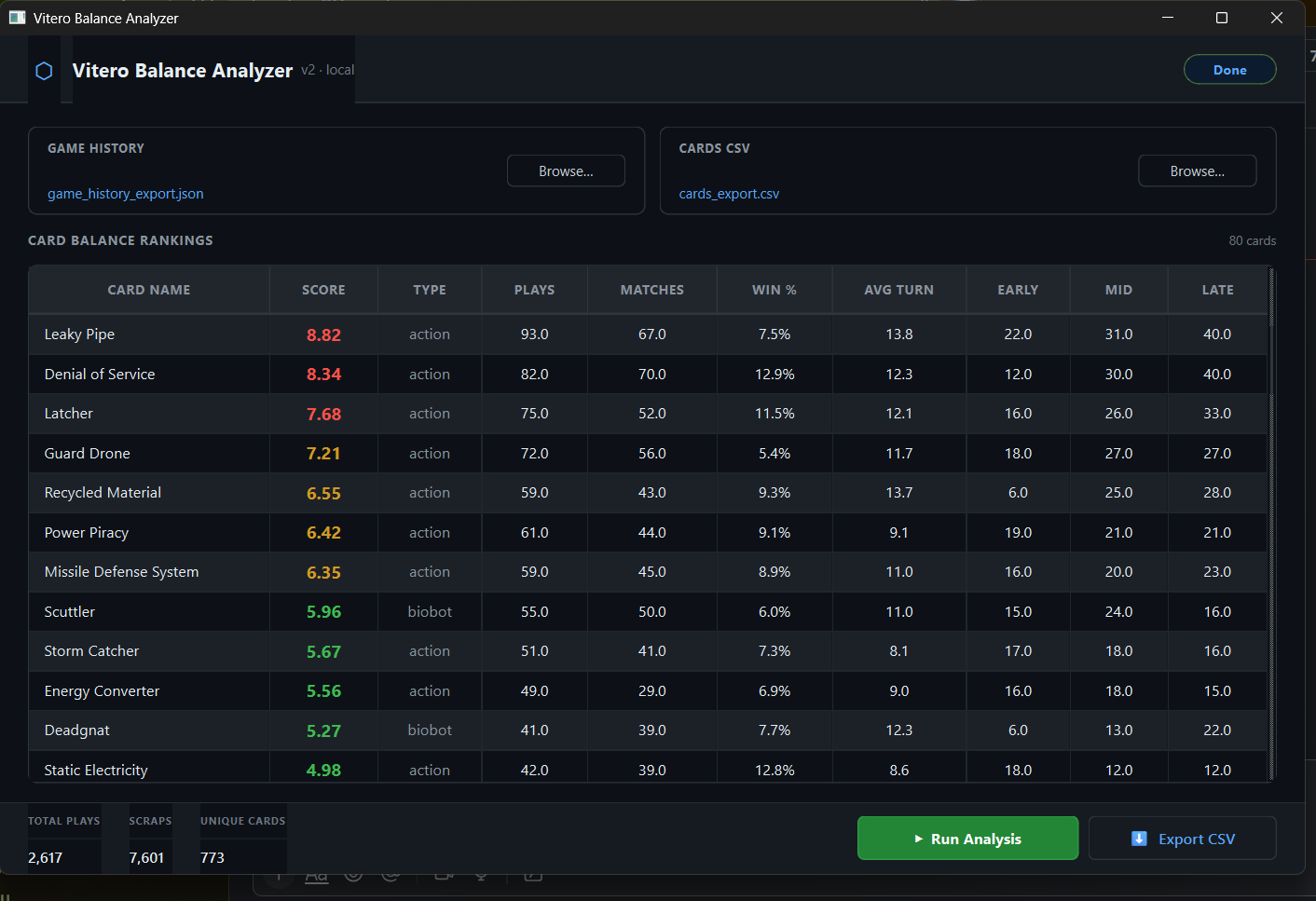
Two Robots AI Card Balancer — live production interface showing faction balance scoring and temporal power curve analysis
▶ FIELD CAPTURE // AI CARD BALANCER UI // PRODUCTION
The live balancer interface showing real-time faction scoring, card power weighting, and temporal curve analysis across all three TRU factions. This system runs continuously — not on patch days, continuously.
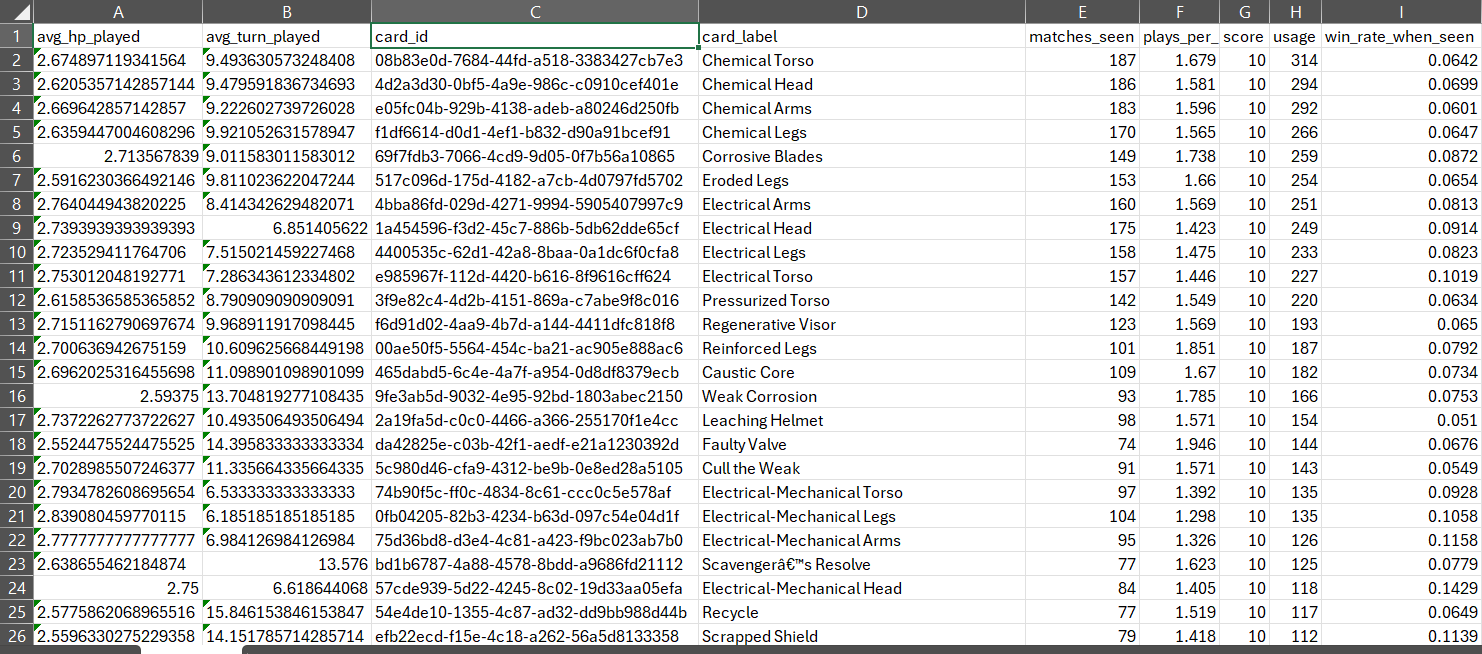
Two Robots card data sample showing relative scoring values used by the AI balancing system
▶ FIELD CAPTURE // CARD SCORING DATA SAMPLE // PRODUCTION
A sample of card scoring data showing relative power values, faction weights, and turn-timing modifiers that feed the balancer. Every card in the game has a structured data profile. The AI reads this, not a spreadsheet.
These are not mockups. Not demos. Not a slide deck screenshot. This is the system that caught Splitflow's turn-one overtuning before a playtester flagged it — and fixed it before the next session. The AI card balancer is the reason our MTG Champion playtester said the game was “worlds better” on their second visit.

WE DO NOT NEED STEAM. WE BUILT OUR OWN DOOR.

▶ TR-PERSTEMICO // ELECTRON CLIENT // STANDALONE WORLD

Two Robots: Unleashed can be downloaded through Steam for discovery. But Steam is not where Rennova lives. The clan system, the territory economy, the social layer, the blockchain-backed wallet, the seasonal Ownership competition — none of it runs through Steam. All of it runs through our standalone Electron client: tr-perstemico.

This was a deliberate architecture decision. Steam does not let you own your player relationship. We do.

CLIENT ARCHITECTURE // ELECTRON + NEXTRON

WHAT THE STANDALONE CLIENT IS

Built on Electron 38 with Nextron (Next.js 14 + React 18). The same technology stack as Discord, Slack, and VS Code.
Cross-platform: Windows primary, macOS and Linux supported. The client handles its own download, sync, and launch of the Godot game binary.
Manifest-based incremental file sync — the client checks which game files have changed and downloads only those. Players never download the whole game twice.
Auto-update via S3 with electron-updater. When we ship a patch, players get it silently. No manual update required. No launcher friction.
CI/CD pipeline: version bump, commit, tag, push — the pipeline builds, publishes to S3, and updates release artifacts automatically. Current version: 1.1.70.
BLOCKCHAIN INTEGRATION // THIRDWEB + SEPOLIA

WALLETS CREATED AUTOMATICALLY. PLAYERS NEVER KNOW.

When a player goes premium in the standalone client, a blockchain wallet is created automatically in the background using Thirdweb in-app wallets with optional Account Abstraction for gasless transactions.
The player does not see a wallet address. They do not sign a transaction. They do not pay gas. The wallet exists and works invisibly — the way a bank account works when you tap a debit card.
District ownership, war timestamps, rent escrow, and payout distribution are settled on Sepolia/Ethereum testnet. USDC stablecoin only. No proprietary token. No ICO.
The wallet is the infrastructure for true asset ownership — Biobot cards, ship skins, territorial stakes — without requiring players to understand blockchain to use it.
Authentication supports Email, Google, Apple, Discord, and passkey. The complexity lives in the backend. The player sees a login button.
CLIENT FRAMEWORK
ELECTRON 38
SAME AS DISCORD + SLACK
WALLET LAYER
THIRDWEB V5
GASLESS // INVISIBLE TO PLAYER
DEPLOYMENT
S3 + ARGO CD
AUTO-UPDATE // ZERO FRICTION
TERM // tr-perstemico-client-map ● ● ●
> tr-perstemico (Electron) → launches Godot game binary via tttr.txt JWT bridge
> player auth → Thirdweb ConnectButton → UserAPI.register → AuthAPI.login → JWT
> JWT stored in Electron safeStorage (OS keychain) + mirrored to tttr.txt for Godot
> premium upgrade → Thirdweb in-app wallet created silently → blockchain access enabled
> game file sync → manifest check → incremental download → S3 delivery
> auto-update → electron-updater → S3 bucket tru-client-releases → silent patch
» clan system, territory, war economy → standalone client only → NOT on Steam
» blockchain settlement → Sepolia testnet → USDC only → no proprietary token
Steam is the discovery layer. The standalone client is the world. Every player who migrates from Steam to our client is a player who chose to go deeper into Rennova — and the Friendship ship they earn when they go premium is the visible proof of that choice to everyone else in the galaxy.
▸ /WHAT-IS-TRU // CH.02
SEE THE GAME THIS CLIENT DELIVERS
The card game. The spectator arena. The Biobot economy. The ship tier system.

THE MOAT IS NOT THE GAME. THE MOAT IS THE INFRASTRUCTURE.

CAPABILITY TWO ROBOTS UNITY STUDIOS UNREAL STUDIOS
ENGINE-LEVEL CUSTOMIZATION ✓ GODOT OPEN SOURCE ✗ CLOSED ✗ CLOSED
TERRAFORM INFRASTRUCTURE ✓ LIVE APR 2026 VARIES VARIES
SERVER-AUTHORITATIVE PHYSICS AT SCALE ✓ ARCHITECTED REQUIRES CUSTOM BUILD REQUIRES CUSTOM BUILD
AI CARD BALANCER IN PRODUCTION ✓ LIVE
100K CCU ON $400 PC HARDWARE ✓ TARGET ARCHITECTED ✗ NOT DESIGNED FOR THIS ✗ NOT DESIGNED FOR THIS
We are not claiming to be ahead of AAA studios in raw resources. We are claiming to be ahead on the specific technical decisions that matter for our specific scale target. That is a meaningful distinction.
▸ /BLACKBOX // CH.06
SEE WHERE THIS INFRASTRUCTURE LEADS
Physical card resurrection. AR/VR horizon. The TRU metaverse. Long horizon pivots.

THAT IS THE ARCHITECTURE. ONE MORE LAYER REMAINS.

▶ HANDOFF // FINAL CHAPTER

This page is the engineering foundation. The next and final page is the long horizon — the creative pivots, the moonshots, the places this project could go that require the right partners in the room. Not the product. Not the infrastructure. The future.

▸ ALL CHAPTERS // SIX LAYERS // ONE PROJECT
▶ FINAL LEVEL // MAXIMUM CLEARANCE
/ BLACKBOX // CH.06
ENTER THE BLACKBOX
LONG HORIZON · MOONSHOTS · CREATIVE PIVOTS
OMAR HAFEZ // CEO   //   XACE LEEM // CO-FOUNDER // STRATEGY + EXECUTION
omar@tworobots.com · xace@tworobots.com · tworobots.com
// END TRANSMISSION